The Last-Second Snipe Plan
A last-second bid timed from your own measured delay and clock: the slowest of five trials, the offset time.gov shows, a lead rounded up so the bid lands early rather than late, and a maximum that still clears the minimum bid when it lands
BidBut's Snipe Timing Calculator subtracts a lead from the auction's close, and its own notes say placement depends on network latency and your clock. It asks for neither. On a phone whose slowest trial took 2.9 seconds and whose clock is 2.4 seconds behind, its default 5-second lead lands 0.3 seconds after the close, while the average trial says there are 0.8 seconds to spare. (We fixed the calculator itself while writing this: it now rounds every moment earlier and refuses a zero lead.) The Last-Second Snipe Plan measures what the calculator cannot. You time your own delay five times and plan from the slowest, add the whole clock offset time.gov reports, and round the lead up: in the worked example, 2.9 + 2.4 + a 2-second margin is 7.3, so an 8-second lead fires at 5:59:52 PM for a 6:00 PM close and lands 2.7 seconds early. Then it checks the number: under automatic bidding the winner pays one increment over the runner-up's maximum, so you snipe your maximum to the cent ($189.37 in the example, never the $165.00 minimum), and you write down the line ($186.87) above which your maximum can no longer be placed. Every figure is an example computed by code from BidBut's own calculators. It promises no win, it quotes eBay's own help pages on sniping and on never handing a sniping service your password, and it is not for pay-per-bid (penny) auctions. Inside: 7 steps, a delay test card, snipe cards, a snipe log, a lead-time table, the increment bands and a quickstart, plus a personalised sheet worked from the numbers in the calculator you came from.
What’s inside
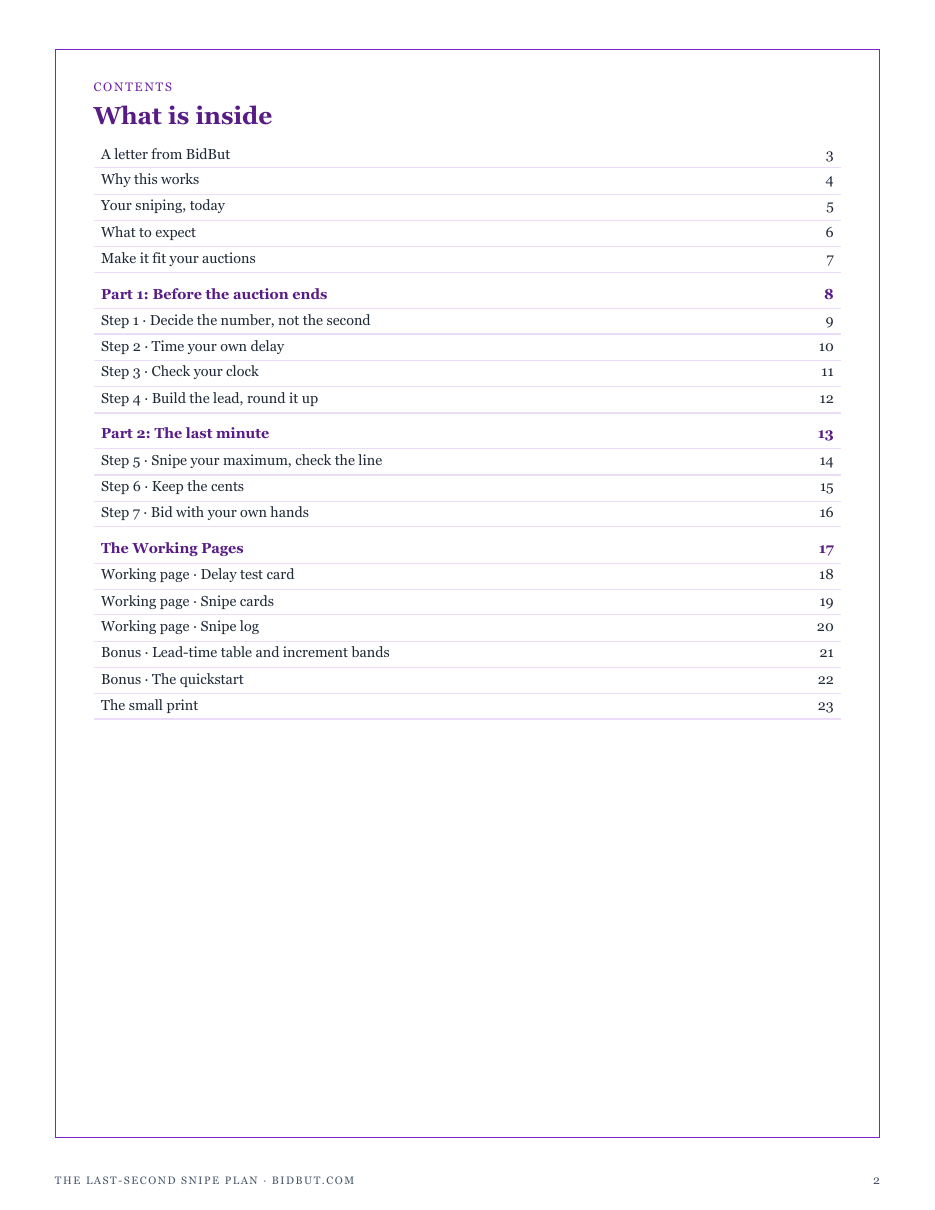
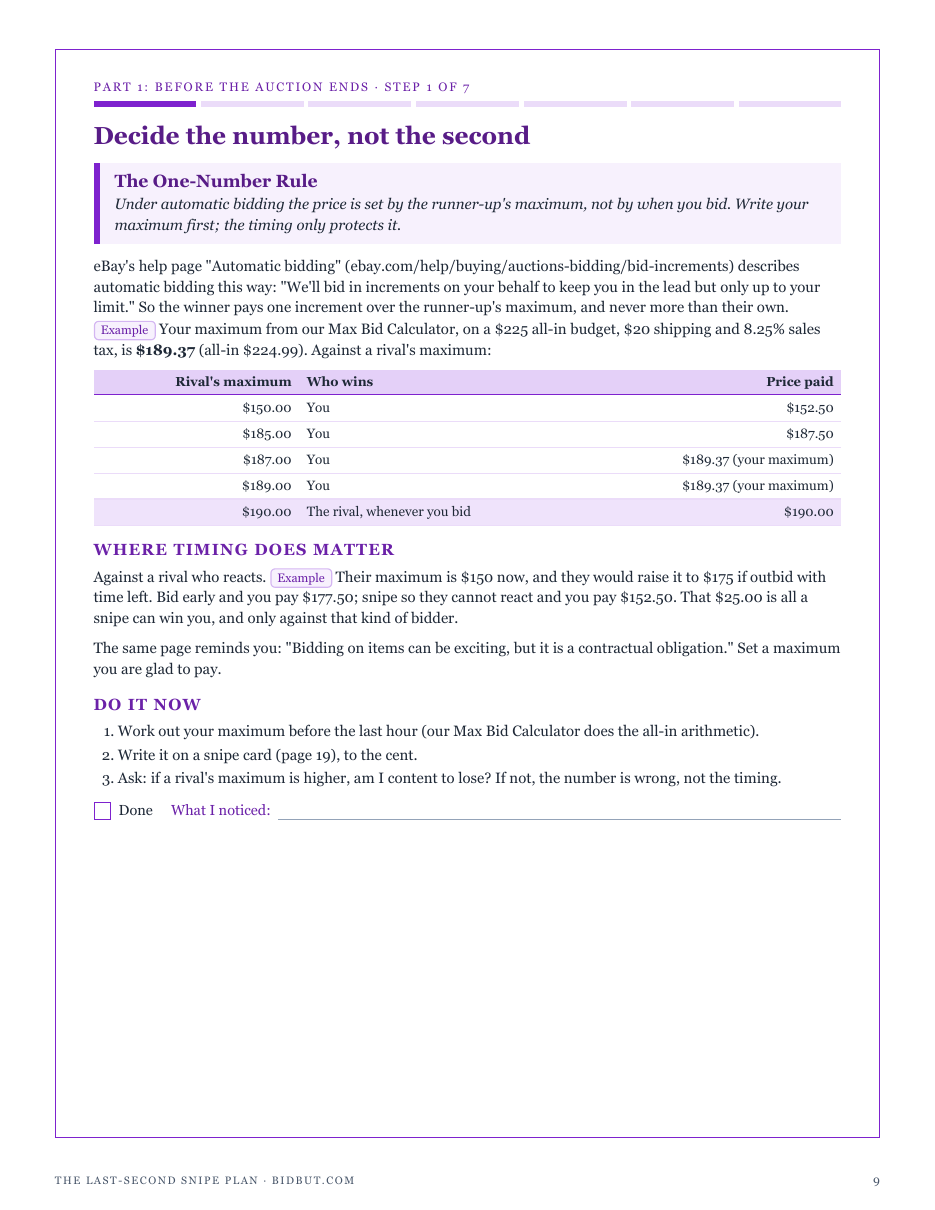
- The One-Number Rule: what a win costs under automatic bidding against each rival maximum, and the one kind of bidder timing can beat
- The Slowest-Trial Rule: five timed trials on your own device and connection, and why the slowest one decides
- The Whole-Offset Rule: your clock checked at time.gov and added whole, whichever way it points
- The Earlier-Second Rule: slowest trial + offset + margin, rounded UP, and the fire time it gives
- The Line Rule: snipe your maximum, not the minimum, and the shown price above which it can no longer be placed
- The Odd-Cents Rule: why the cents of your maximum stay, and what rounding up or to a tidy number costs
- The Own-Hands Rule: no password to any sniping service, and a log of where each bid really landed
- Three printable working pages: delay test card, snipe cards, snipe log
- Reference tables: the lead to enter by slowest trial and clock offset, the increment bands, and the formulas
- A quickstart checklist and a personalised sheet worked from your own calculator inputs
Run one of the free calculators first and buy from that page, and this sheet is computed from your own figures. Buy from here and the pack still arrives complete — the sheet simply has no numbers of yours to work from yet.
14-day refund, no questions asked. If the pack is not what you needed, email support@graburl.com and we refund you in full — you do not have to justify it or delete the file. Full policy.
$15.00 including any taxes · PDF, 23 pages · instant download, link valid 7 days and 5 downloads.
Sold by GrabURL. The charge appears on your statement as GrabURL.
Refund policy · Terms of sale · support@graburl.com