The Walk-Away Bid Kit
Set a maximum bid from what a lot really costs out the door: every invoice line, a ceiling divided back to a hammer price, rounded down to a rung, the next rung priced before the lot opens, and a flip's ceiling from its sold price
BidHalf's Maximum Bid Calculator, Total Cost-to-Win Estimator and Auction Fee calculator each assume a different invoice, and none has a line for a card surcharge. The Auction Fee calculator taxes a flat lot fee where the other two do not, so the same lot gets three totals; the Maximum Bid Calculator gives a bid to the cent that a live or timed sale may not take; and the Resale Profit & Margin Estimator runs forward, from cost to profit, when a bid needs it run backward. The pack writes your auction's whole invoice down once and works every ceiling back from it by division, never by subtracting or adding percentages. Example: on an 18% premium, 7% tax, a $3.00 lot fee, a 3% card fee and $25.00 shipping, a $150 hammer is $223.38 out the door; fed a $500 ceiling and every field it asks for, our Maximum Bid Calculator's bid costs $514.47, while the pack's divided bid is $362.70 and its last rung is $360.00. For a flip, a $350 sold price with a $60 profit set first gives a $224.20 ceiling, a $150.63 max and a $150.00 rung, and leaves $14.33 at that ceiling if it sells 15% under. Each rung past your card is priced in all-in dollars: $3.25 for a $2.50 step. Every figure is computed from the site's own calculators and tagged as an example, and the increment schedule is the site's example, not any auction's. No profit is promised, it is not for pay-per-bid ("penny") auctions, and it is not tax advice. Includes 7 steps, an auction terms sheet, walk-away cards, a flip ceiling sheet, a bid log, per-dollar and rung tables, a quickstart, and a personalised sheet worked from the numbers you entered in our calculators.
What’s inside
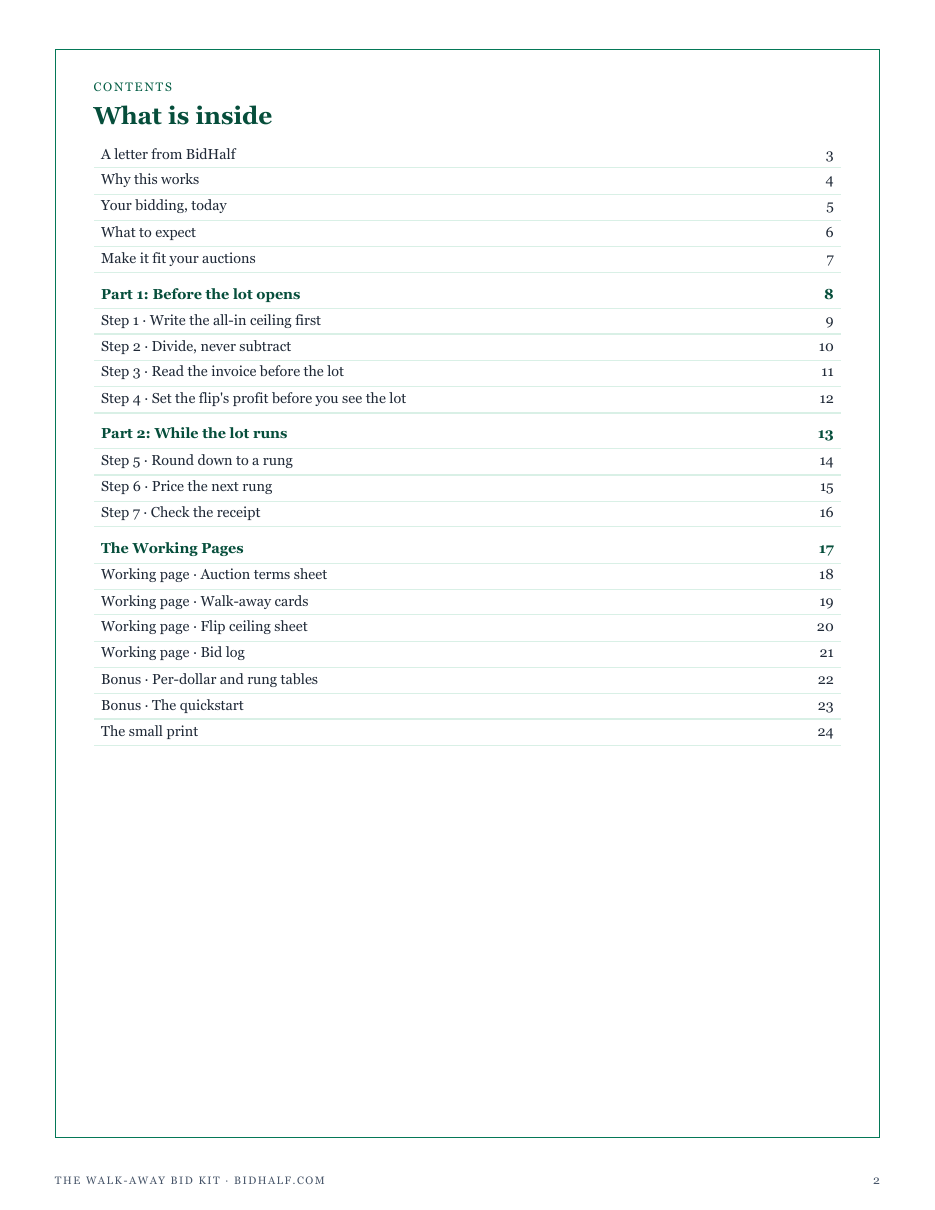
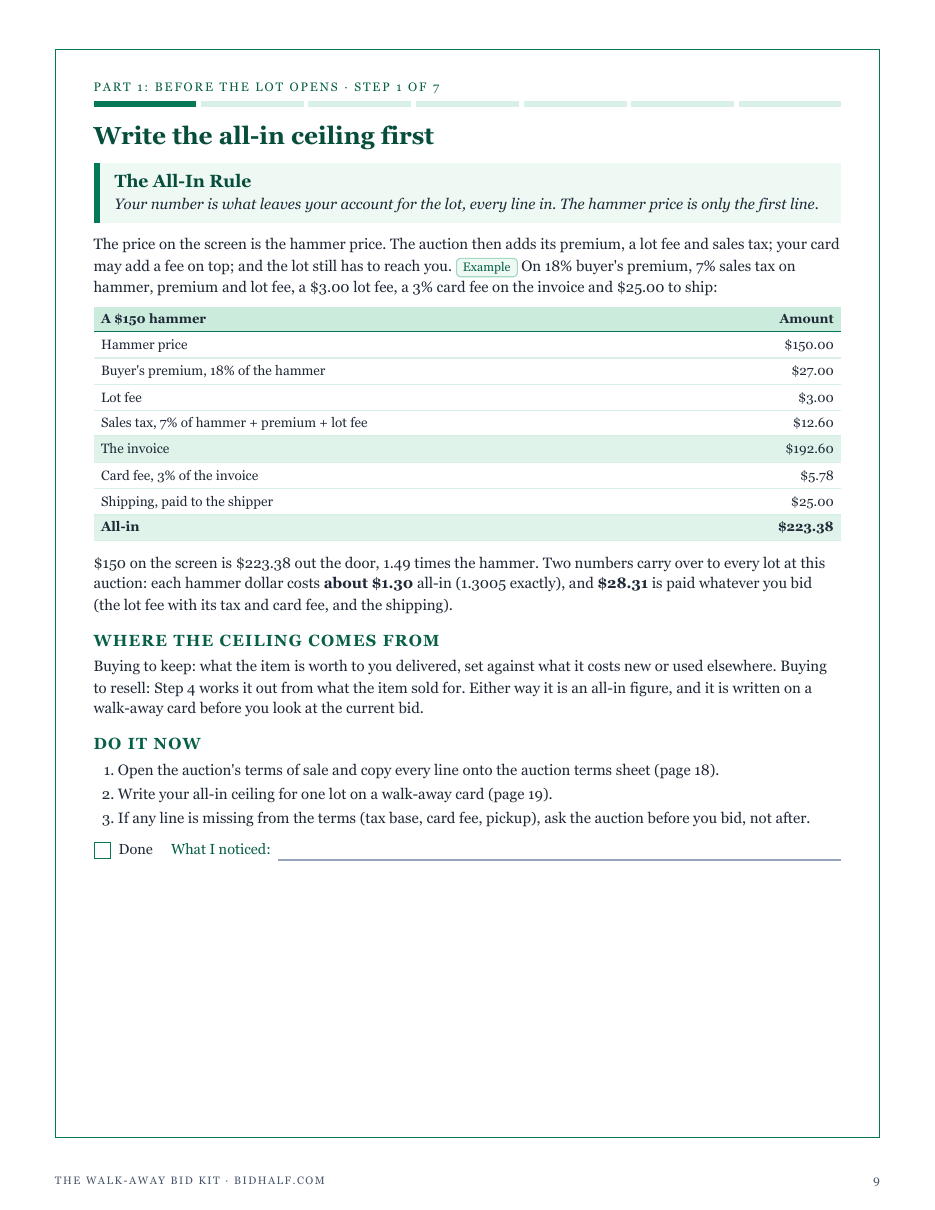
- Step 1: write the all-in ceiling first: every line a hammer price carries, and the two numbers that carry over to every lot
- Step 2: divide, never subtract: why subtracting the percentages bids too low and adding them bids too high
- Step 3: read the invoice before the lot: our three calculators reconciled, and five questions for the terms of sale
- Step 4: set the flip's profit before you see the lot: a sold price run backward to a ceiling, and the 15% cushion test
- Step 5: round down to a rung: a max bid to the cent, then the highest rung the auction will take
- Step 6: price the next rung: what one more increment costs all-in, and when your hand stays down
- Step 7: check the receipt: the invoice against your card, and a log that keeps the ceilings honest
- Working pages: an auction terms sheet, walk-away cards, a flip ceiling sheet and a bid log
- Reference tables: what one hammer dollar costs by premium and tax, and what one rung costs all-in by price band
- A quickstart, the arithmetic on one card, and a personalised sheet worked from your own calculator numbers
Run one of the free calculators first and buy from that page, and this sheet is computed from your own figures. Buy from here and the pack still arrives complete — the sheet simply has no numbers of yours to work from yet.
14-day refund, no questions asked. If the pack is not what you needed, email support@graburl.com and we refund you in full — you do not have to justify it or delete the file. Full policy.
$19.00 including any taxes · PDF, 24 pages · instant download, link valid 7 days and 5 downloads.
Sold by GrabURL. The charge appears on your statement as GrabURL.
Refund policy · Terms of sale · support@graburl.com