The Spoilage Pack
An order is a number of good shirts; the press is paid for every shirt it takes. What the difference costs, and what it does to a price you have already quoted
The cost-per-print calculator on this site is correct arithmetic. It rests on one assumption it never states — that every print in the run is sellable — and no shop's is. To hand over a hundred good shirts at six percent spoilage you do not print a hundred. You print a hundred and seven, and you pay for all of them: the blank, the ink, the labour, the floor time. Divide by the hundred the customer pays for and a good print costs 6.28 where the calculator reports 5.90. Quote from the calculator's figure at a 40% target and you make 36.1%. Nothing about the calculation was wrong. The price was right for the cost you worked out, and the cost you worked out was for a run with no spoilage in it — so the shortfall never appears anywhere. Every figure on the invoice is correct; the money is simply not there at the end of the month. The pack runs your own job at a range of spoilage rates, because nobody knows theirs to a decimal. Between a good week and a bad one the margin on the same job at the same price moves from 40% to 26.1% without anything else changing. If you do not know which row you are on, you do not know what your shop earns — and the fix costs a tally sheet and four weeks. Short runs get their own page, because setup is paid once however many you print and lands hardest where spoilage does. A twelve-shirt job at the same price makes 2.11 where the calculator implies 7.56: more than three times as much, for burning a screen, mixing ink, setting up, printing, cleaning down and packing. Two numbers worth writing on the wall: the spoilage rate at which a job stops paying at all (41.9% on the worked example — far above anything a working shop sees, which is why the real damage is quiet rather than dramatic), and the order size below which an outside quote beats your own press once setup is counted. That second one is the calculation nobody selling screens, emulsion or a press is going to run for you. A page is given to what actually moves spoilage — exposure, mesh, cure, registration — and is honest that changing it is craft rather than arithmetic, including the reject that is in no tally at all: the under-cured print that passes every check, fails in the wash weeks later, and costs you the print, the blank, the postage both ways and the customer. No industry spoilage rates, supplier prices or benchmarks anywhere, because none would be about your shop, and money carries no currency symbol. It ends with a sheet of the nine lines the whole thing runs on, and if you buy from the calculator page your own job arrives already costed.
What’s inside
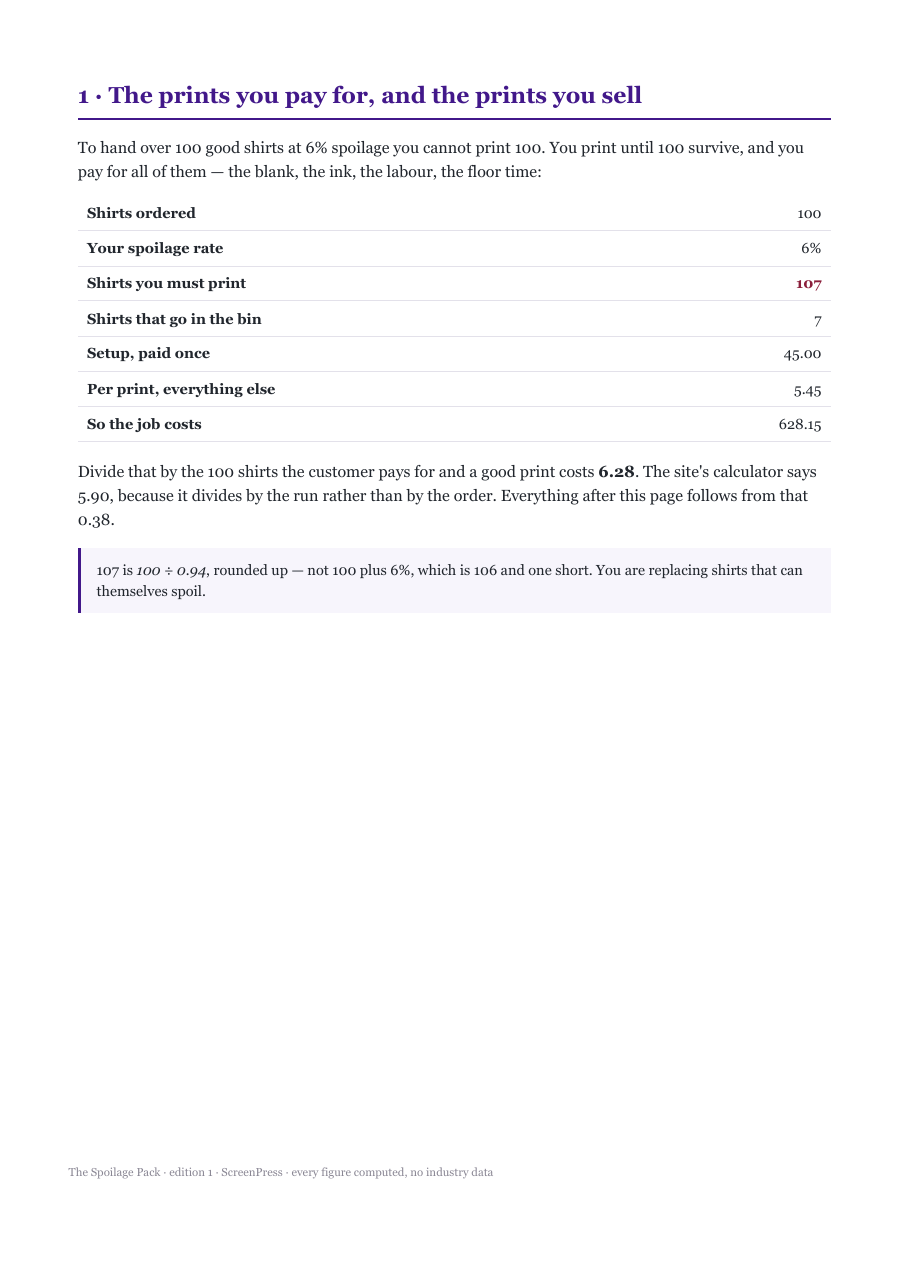
- The prints you pay for against the prints you sell, and why it is a division not an addition
- What that does to a price you have already quoted, and why the shortfall is invisible
- The same job across six spoilage rates, all at one price
- Why the margin swings by fourteen points without anything else changing
- The small run, where setup and spoilage compound
- The spoilage rate at which a job stops paying altogether
- When to leave the press idle — the order size below which an outside quote wins
- What actually moves spoilage, and the reject that is in no tally at all
- What this does not settle, stated plainly
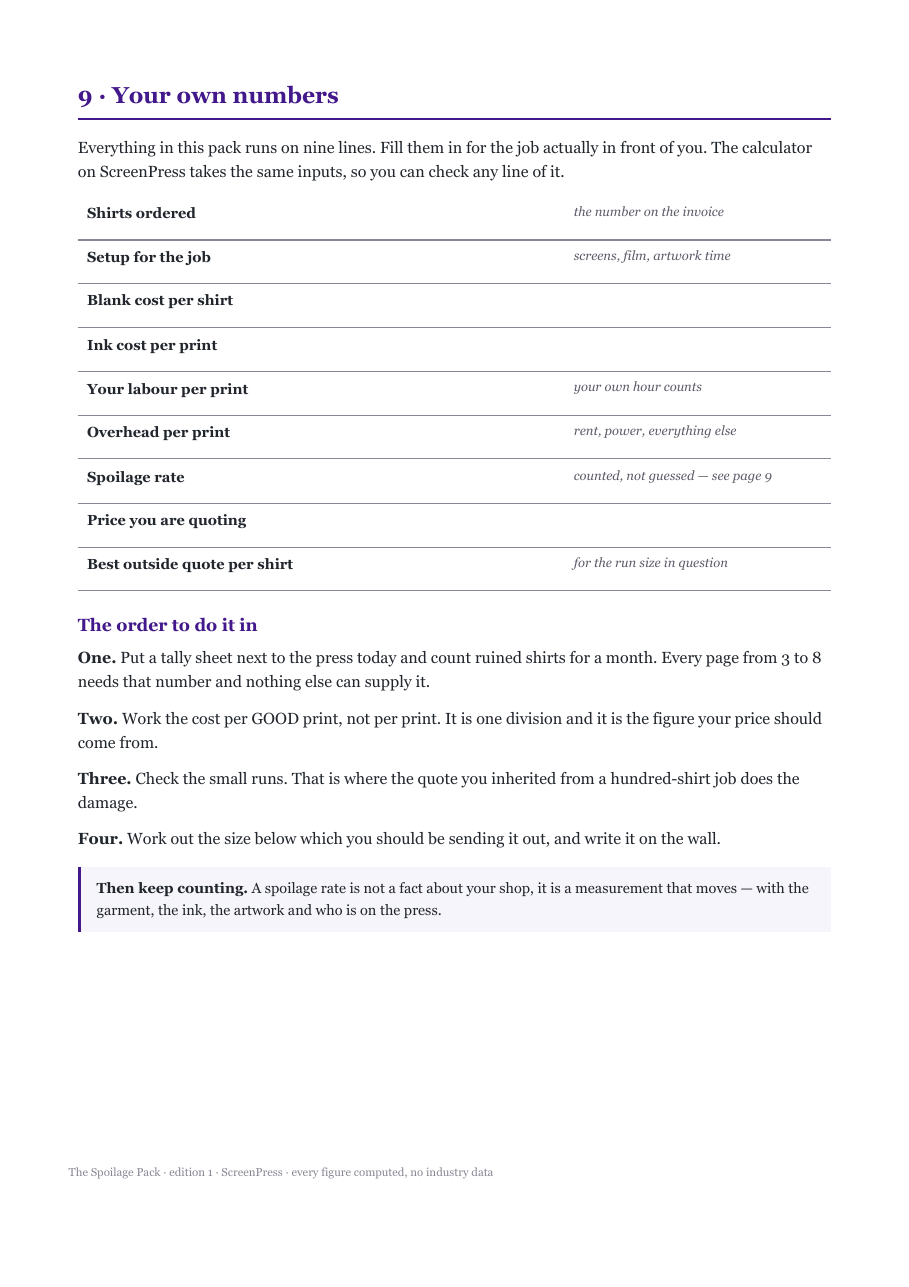
- Your own numbers — the nine lines the pack runs on, and the order to work through them
Run one of the free calculators first and buy from that page, and this sheet is computed from your own figures. Buy from here and the pack still arrives complete — the sheet simply has no numbers of yours to work from yet.
14-day refund, no questions asked. If the pack is not what you needed, email support@graburl.com and we refund you in full — you do not have to justify it or delete the file. Full policy.
$19.00 including any taxes · PDF, 11 pages · instant download, link valid 7 days and 5 downloads.
Sold by GrabURL. The charge appears on your statement as GrabURL.
Refund policy · Terms of sale · support@graburl.com