The Belt Drive Plan
A two-pulley drive worked from your own measurements: the pulley pair for the speed you want, checked at the motor's unloaded speed against the maximum marked on the driven part, and the stock belt that fits your motor's slot with room left to take up stretch
Our Belt & Pulley Calculator turns two pulley diameters and a center distance into a speed and one belt length, and its own note says to allow for take-up when you choose a stock belt. It cannot say which stock belt, and it takes one motor speed where an induction motor has two: the nameplate's full-load speed, and the faster synchronous speed it nears with no load. The Belt Drive Plan works both out on your drive. In the worked example, a 1,725 rpm nameplate motor wants 2,400 rpm at a buffing arbor: of 30 pulley pairs, 125 mm into 90 mm gives 2,396 rpm, and 2,500 unloaded, under the buff's 2,900 rpm marking, while 125 into 75 reads 2,875 at the nameplate and 3,000 unloaded, over it. On a 300 to 350 mm motor slot the belts that fit run from 938.7 to 1,038.6 mm; the 975 mm belt lands 36% along with 31.8 mm left to take up stretch, where the calculator's 988.7 mm, ordered as 1,000 mm, leaves 19.3. A 250 rpm drive is split over two stages instead of a 434.7 mm pulley wrapping the small one 124.6 degrees. Every figure is computed by the code behind our calculators, and every motor, pulley, slot, belt and marking is an example for you to replace; landing a third of the way along the slot is our rule of thumb. It is not a torque specification, a lifting design or a belt power rating. It carries the facts a belt drive needs, quoted from OSHA: the spindle speed checked against the maximum marked on the wheel, and pulleys and belts guarded. Inside: seven steps, four printable working pages, reference tables and a quickstart, plus a personalised sheet worked from the numbers you enter in our Belt & Pulley and Gear Ratio calculators.
What’s inside
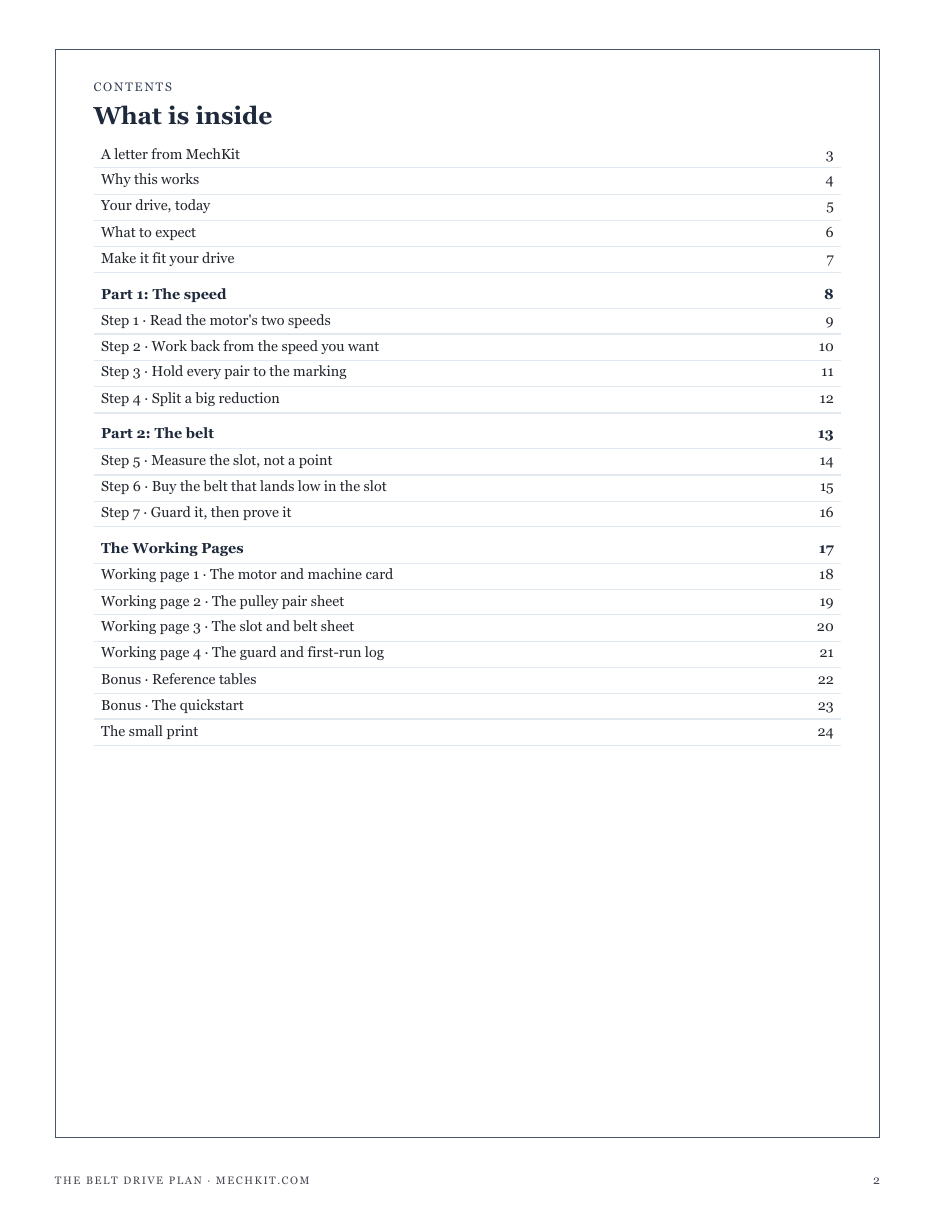
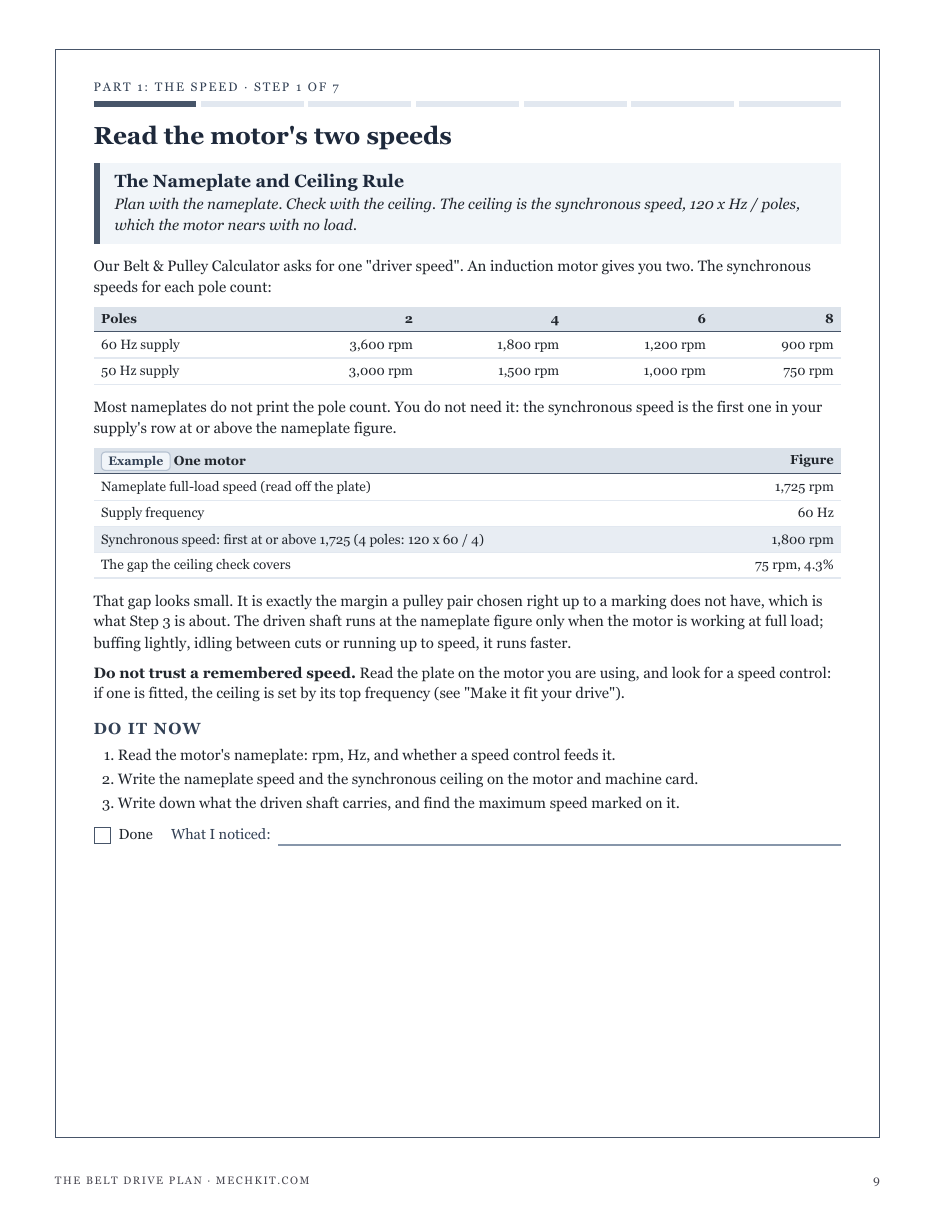
- The Nameplate and Ceiling Rule: your motor's full-load speed and its synchronous ceiling, 120 x Hz / poles
- The Ratio First Rule: the pulley pair worked back from the speed you want, every pair tried at both speeds
- The Marking Rule: every pair held at the unloaded speed to the maximum marked on the driven part
- The Two Stage Rule: a big reduction split belt into belt or belt into a gear pair, with each wrap worked
- The Slot Window Rule: the window of belt lengths your motor slot accepts, from both ends of its travel
- The Take-Up Rule: the stock belt that lands about a third along the slot, with room to fit and to take up
- The No Guard, No Run Rule: guarding quoted from OSHA, isolation, tensioning and a tachometer first run
- Four printable working pages: motor and machine card, pulley pair sheet, slot and belt sheet, guard and first-run log
- Reference tables: synchronous speeds at 50 and 60 Hz, a driven speed grid at nameplate and ceiling, and the formulas
- A quickstart checklist and a personalised sheet worked from your own calculator inputs
Run one of the free calculators first and buy from that page, and this sheet is computed from your own figures. Buy from here and the pack still arrives complete — the sheet simply has no numbers of yours to work from yet.
14-day refund, no questions asked. If the pack is not what you needed, email support@graburl.com and we refund you in full — you do not have to justify it or delete the file. Full policy.
$15.00 including any taxes · PDF, 24 pages · instant download, link valid 7 days and 5 downloads.
Sold by GrabURL. The charge appears on your statement as GrabURL.
Refund policy · Terms of sale · support@graburl.com