The Clean Voice Plan
Work the mic inside your room's reach, put every voice at one distance, land each platform's loudness target under its peak ceiling, and export a file the right size
MikeLoss's free Mic Distance & Gain calculator gives the inverse-square level change: about 6 dB quieter for every doubling of distance. That holds for a small source in open air, and the calculator's page says it does not model the room. You record in a room, where the reflected sound stays at roughly the same level wherever you sit, so moving back makes the room louder compared with you. While writing this plan we checked our own calculators and changed two: our RT60 estimator called a room at 0.51 s "well suited" despite its own 0.3 to 0.5 s aim, and our loudness calculator offered Audible as a -19 LUFS target checked against a -1 dBTP ceiling, when ACX measures RMS and wants peaks below -3 dB. The Clean Voice Plan takes your room from the RT60 estimator and works out its critical distance, the point where the room is as loud as your voice. In the worked example (an example, not a promise), a 4 x 3.5 x 2.5 m spare bedroom has an RT60 of 0.72 s and a critical distance of 69 cm on a cardioid; moving from 30 cm to 10 cm lifts the voice above the room from 7.2 dB to 16.8 dB for nothing, while panels taking the room to 0.35 average absorption buy 4.7 dB and take about 31 of them. Then it puts every voice at one distance, lands a platform's published target under a true-peak ceiling (an episode at -21.4 LUFS needs +5.4 dB for Apple's -16 and a limiter taking 2.3 dB off its peaks), and sizes recordings and exports. It is a planning aid, not acoustic consulting or legal advice. The room figures are rules of thumb from a Sabine estimate; every loudness target names its source and the month it was checked, and platforms change them, so check before you rely on one. It quotes NIOSH's exposure limits and says to monitor at moderate levels; music in a show needs the rights. Included: 23 printable pages, seven steps, a room and mic card, an episode delivery sheet, a session log, room and file reference tables, a quickstart, and a personalised sheet worked on the figures you entered in our calculators.
What’s inside
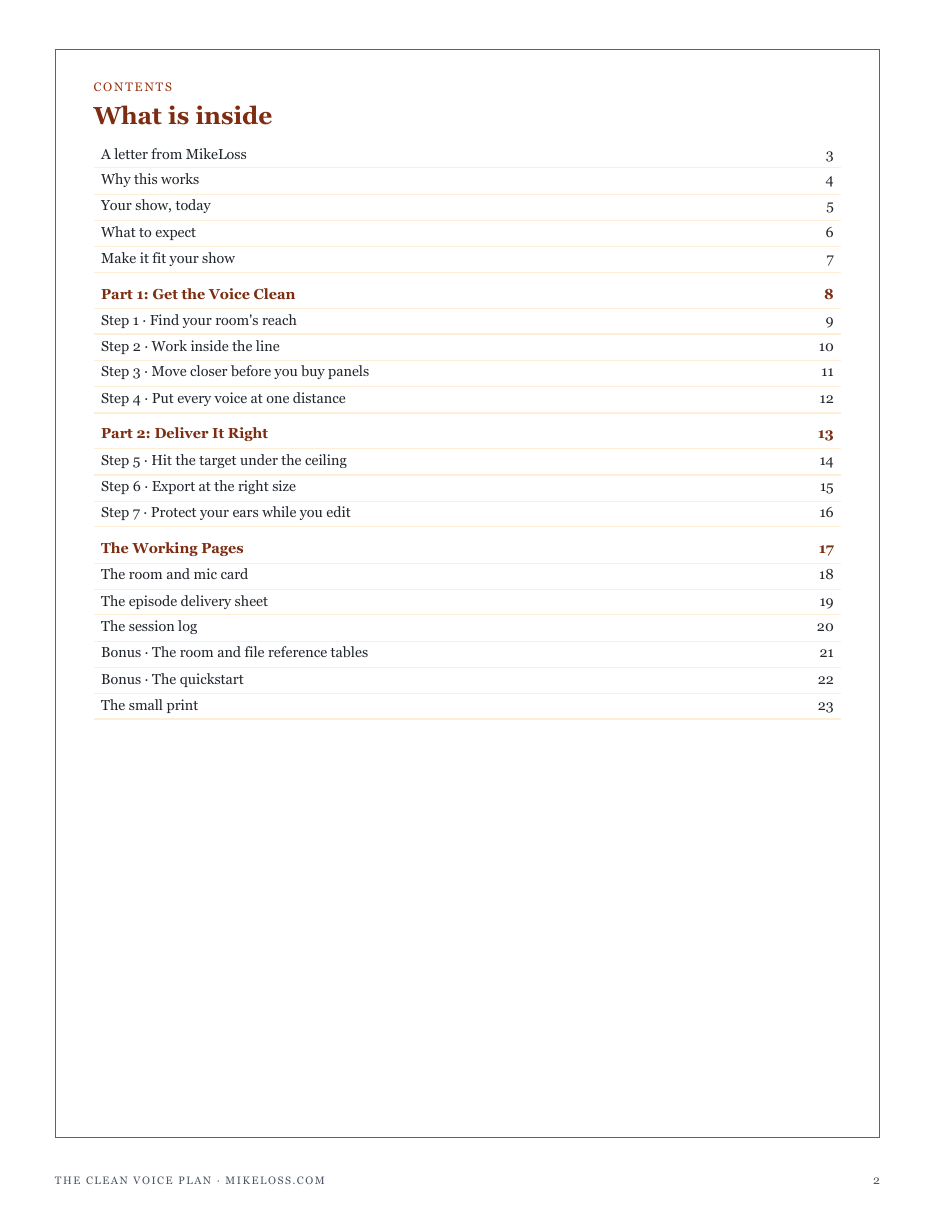
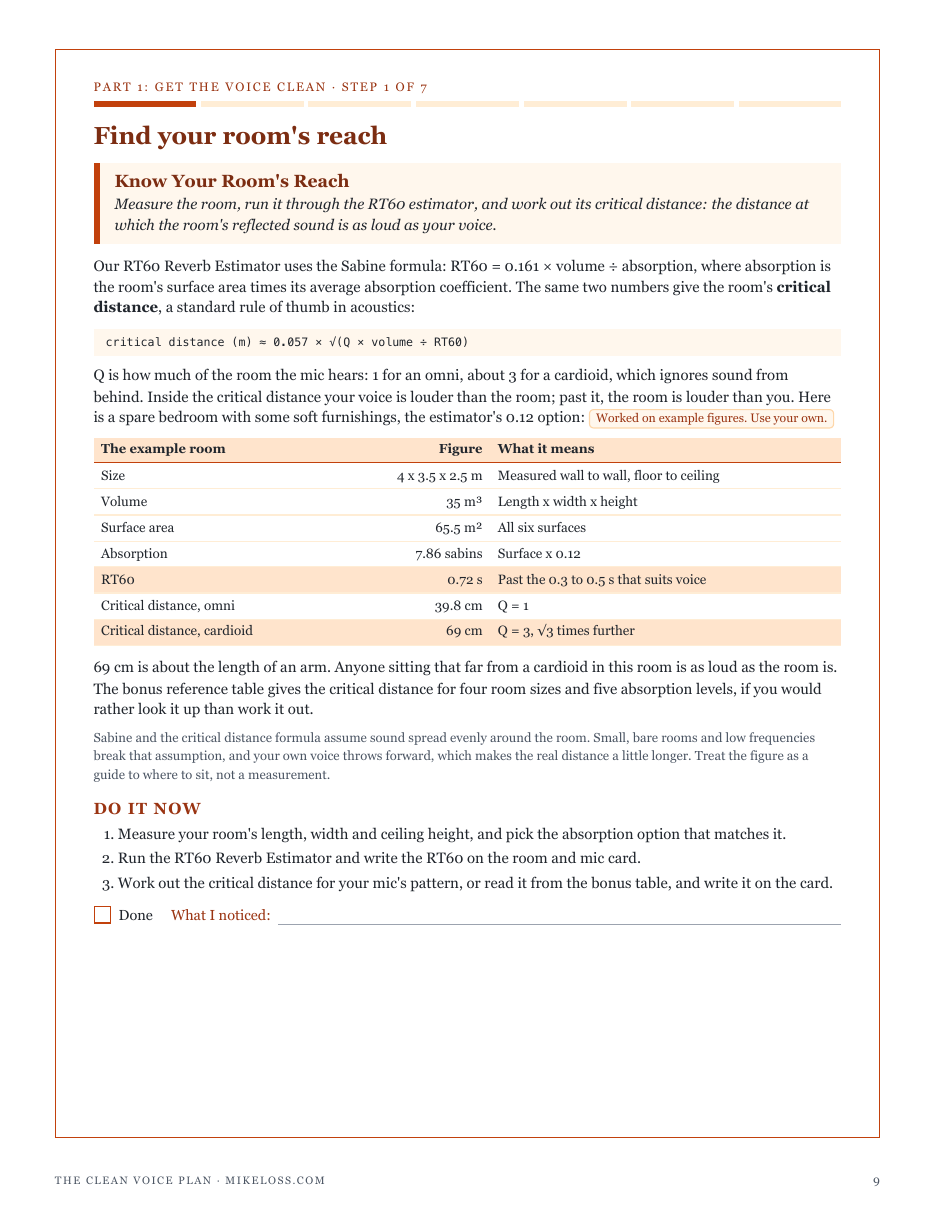
- Know Your Room's Reach: your room's RT60 and its critical distance, where the room is as loud as your voice
- Inside the Line: the distance that keeps your voice 10 dB clear of the room, for a cardioid and an omni
- Closer Beats Panels: what moving closer, soft furnishings and panels each buy, and how many panels a target takes
- One Distance, Every Voice: why gain can match two voices' levels but not their rooms, and how much leaks between mics
- Target, Then Ceiling: each platform's published target with its source and date, the limiter it needs, and what happens without one
- Bits Are Not Bytes: recording sizes per hour and per card, and mono or stereo exports sized for a month of episodes
- Level Before Loud: NIOSH's listening limits, and why you normalize before you edit
- The room and mic card and the episode delivery sheet, printable
- The session log for listening hours, breaks and backups, printable
- Critical distance and file size reference tables, and a one-page quickstart
Run one of the free calculators first and buy from that page, and this sheet is computed from your own figures. Buy from here and the pack still arrives complete — the sheet simply has no numbers of yours to work from yet.
14-day refund, no questions asked. If the pack is not what you needed, email support@graburl.com and we refund you in full — you do not have to justify it or delete the file. Full policy.
$15.00 including any taxes · PDF, 23 pages · instant download, link valid 7 days and 5 downloads.
Sold by GrabURL. The charge appears on your statement as GrabURL.
Refund policy · Terms of sale · support@graburl.com