The Pollination Contract Kit
Price a pollination rental against what it really costs you: the colonies that meet the contract's strength floor, every load's four legs, your hours, feed and the colonies that come back weak, the rate a colony that covers it, the distance where a rate stops paying, and the contract terms that protect it.
MoreBees' Pollination Service Calculator turns a crop, a hive count and a distance into a rental fee, and its own page tells the beekeeper to factor in both delivery and pickup trips and to compare the income against the costs. No tool on the site did that comparison: what the move costs leg by leg, what your hours are worth, what the contract uses up in feed and colonies, and which rate actually covers it. The Pollination Contract Kit works it out. An example: 34 colonies that pass a six-frame floor, going to an apple grower 85 miles away. The calculator says $1,556.25. Three loads at four legs each, plus two visits, is 1,360 miles; with feed, two replaced colonies and other costs the bill is $1,599.50 in cash and $2,423.94 with your time at $20 an hour. Covering it takes $47.05 a colony in cash, or $71.30 with your time (rounded up). At $45 a colony the fee covers the cash bill only out to 78 miles, and 36 with your time. Every figure is an example computed by the code the site's calculator runs; it promises no income. The strength floor and contract terms are quoted verbatim from Oregon State University Extension and the UF/IFAS sample pollination agreement (inspection, extra moves, the 24 to 48 hour notice, compensation, payment); it is not legal advice. It has no line for mites and gives no treatment, medication or dose: for mites, use only a product registered where you live, exactly as its label says. It carries MedlinePlus's sting emergency signs and a veil for every move. You get a 24-page printable kit with four working pages, and a personalised sheet worked on the contract you enter in the calculator.
What’s inside
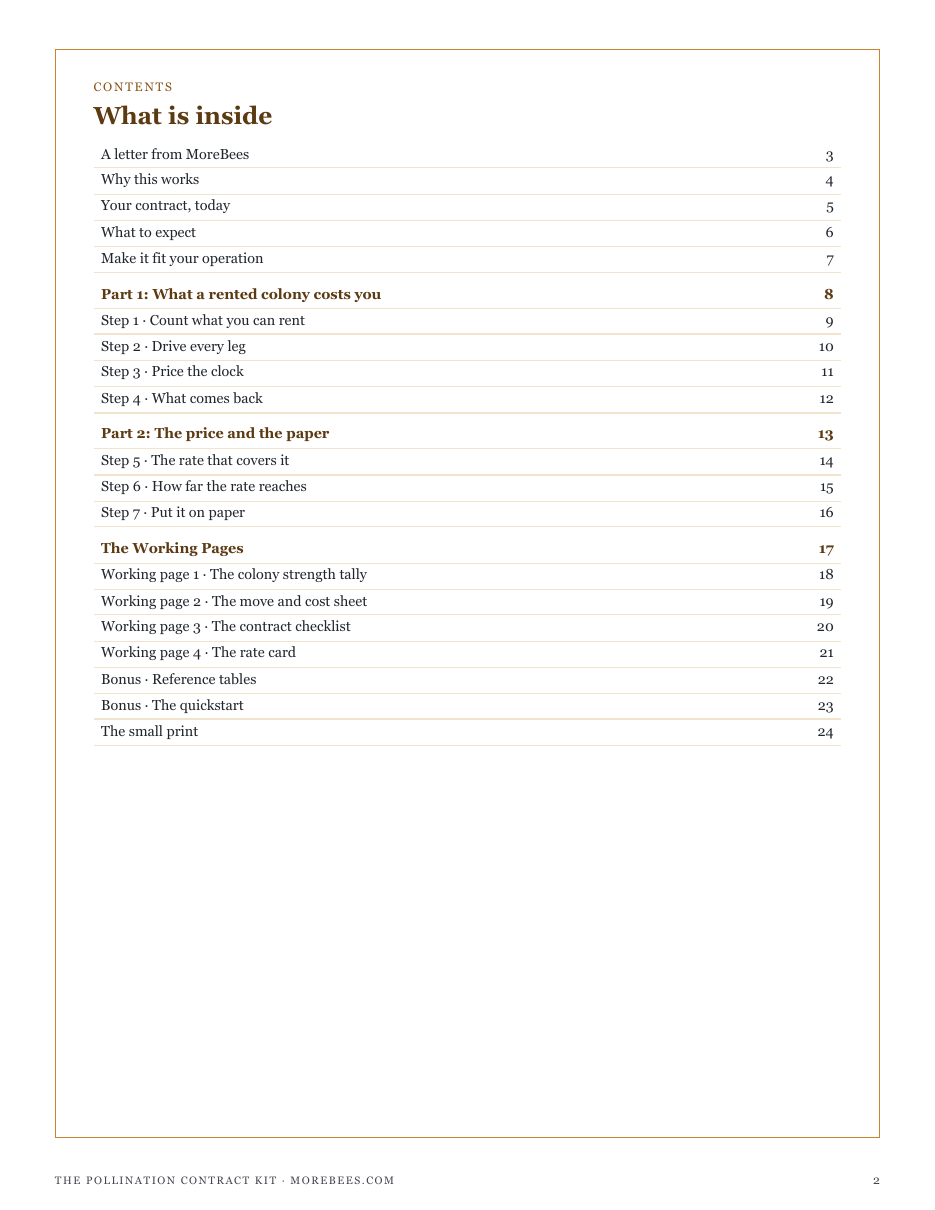
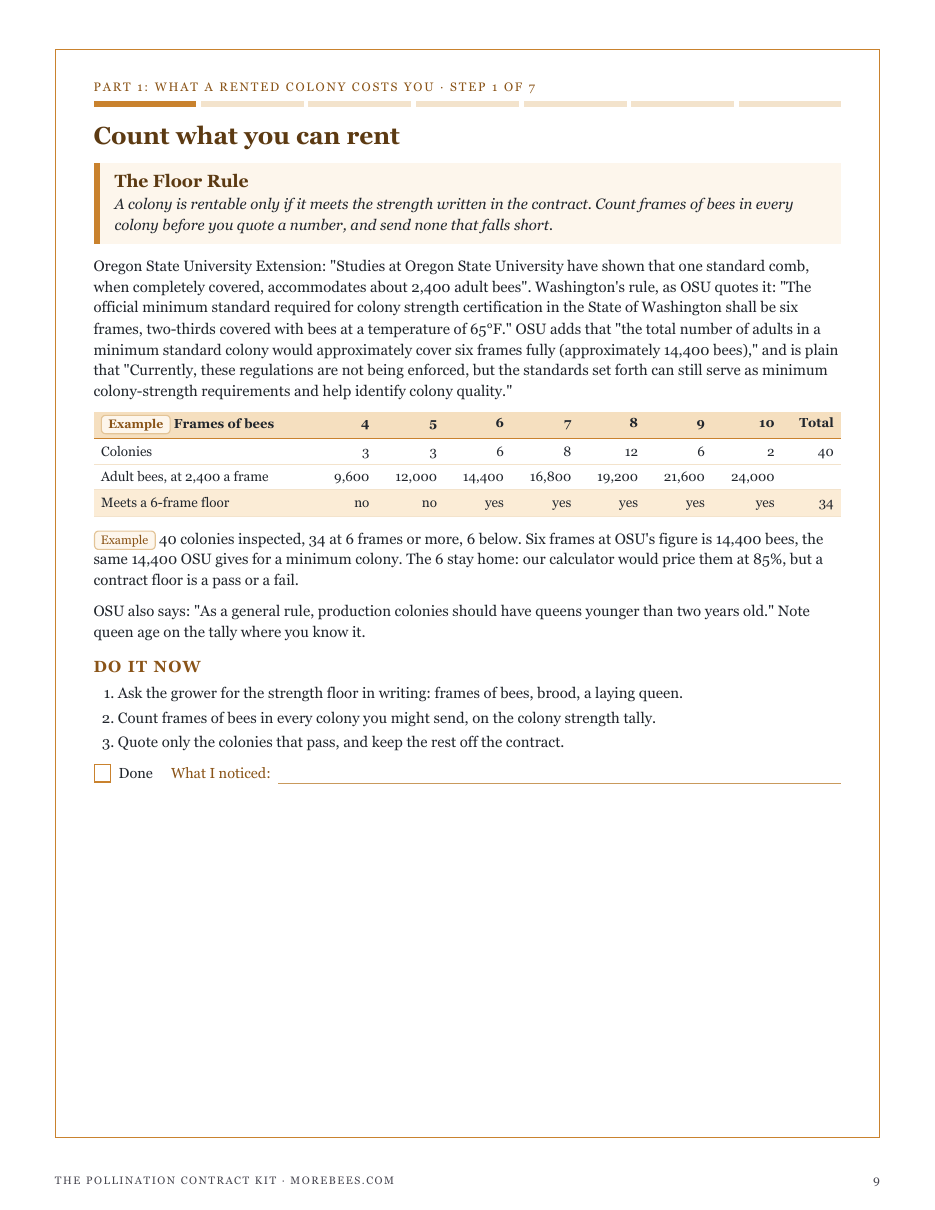
- Step 1: colonies counted against the contract's strength floor, with Oregon State University's bees a frame and Washington's six-frame standard quoted
- Step 2: the move priced leg by leg, four legs a load plus visits, at your own cost a mile, with the sting emergency signs
- Step 3: driving, loading and crop hours, priced at the hourly figure you choose
- Step 4: feed and the colonies you replace after the contract, rounded up, and the whole bill, cash and with your time
- Step 5: the floor price a colony that covers the bill, rounded up to the cent and checked
- Step 6: the break-even distance at the rate on the table, rounded down to a whole mile and plugged back in
- Step 7: the UF/IFAS sample agreement's terms that protect the rate, quoted verbatim, with an extra move priced per colony
- Four working pages: a colony strength tally, a move and cost sheet, a contract checklist and a rate card
- Reference tables: miles a colony by load size and distance, bees by frames, break-even distance by rate, and the calculator's starting rates
- A quickstart that closes the loop on your own before-and-after scores
Run one of the free calculators first and buy from that page, and this sheet is computed from your own figures. Buy from here and the pack still arrives complete — the sheet simply has no numbers of yours to work from yet.
14-day refund, no questions asked. If the pack is not what you needed, email support@graburl.com and we refund you in full — you do not have to justify it or delete the file. Full policy.
$15.00 including any taxes · PDF, 24 pages · instant download, link valid 7 days and 5 downloads.
Sold by GrabURL. The charge appears on your statement as GrabURL.
Refund policy · Terms of sale · support@graburl.com