The Two-Way Link Plan
A radio link that works in both directions: the path loss at your real distance and frequency, the clearance the path needs, the cable that eats your gain, a fade margin you can keep, and the cheapest legal dB for the weaker direction
OpenLTE's RF Link Budget Calculator works one direction: the power sent from one end, the gains and losses in between, and the margin over the other end's sensitivity. A real link runs both ways, usually with different radios at each end, and the weaker direction is the link. The path loss it takes is the free-space best case, which assumes a clear zone around the line of sight nobody has checked, and the calculator never meets the ceiling on what each end may radiate. The Two-Way Link Plan runs the budget from both ends with the site's own calculators. In its worked 8 km, 2,400 MHz example the link closes by 8.39 dB one way and only 5.39 dB the other; kept to a 10 dB fade margin it reaches 4.71 km, not the 8 km it needs. The plan checks the clearance the path needs (10.43 m above the obstacles at the midpoint), counts the cable at both ends, and prices each fix by what it adds to the weaker direction: an amplifier at the strong end adds 0 dB, one at the weak end adds 3 dB and breaks the example EIRP ceiling, while moving both radios up to their antennas adds 5.06 dB both ways and stays under it. Every figure is computed from invented example radios, cables and ceilings, tagged as examples; rules of thumb are called rules of thumb, and no radio, antenna, amplifier or vendor is recommended. It says to check the licensing and EIRP rules for your band and country, gives no advice on exceeding limits or on interference, and includes an RF exposure first screen and tower and roof safety. Included: 24 printable pages with 7 steps, a two-way budget sheet, a path survey sheet, an upgrade ledger and two reference pages, plus a personalised sheet worked from the figures you enter in the link budget, path loss, power and antenna gain calculators.
What’s inside
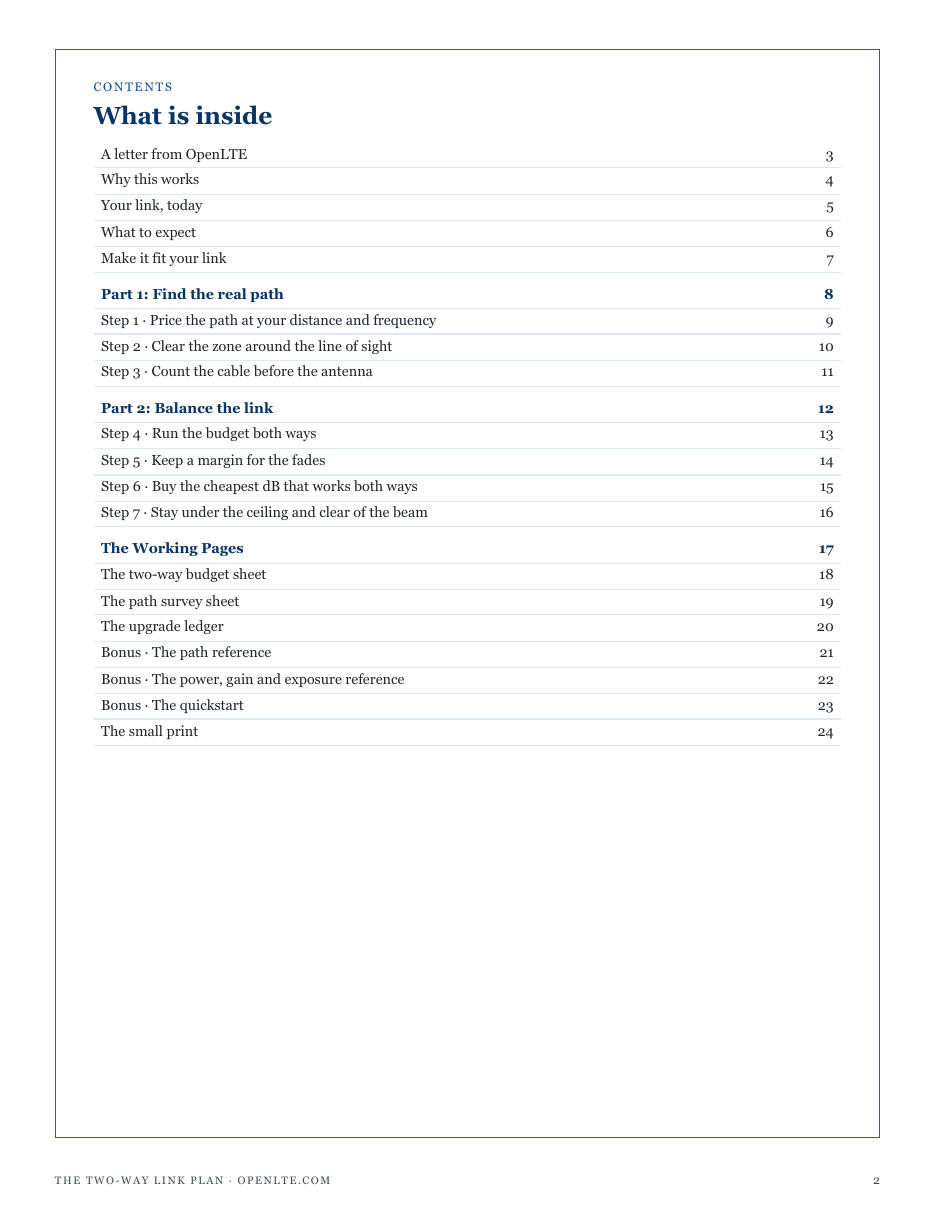
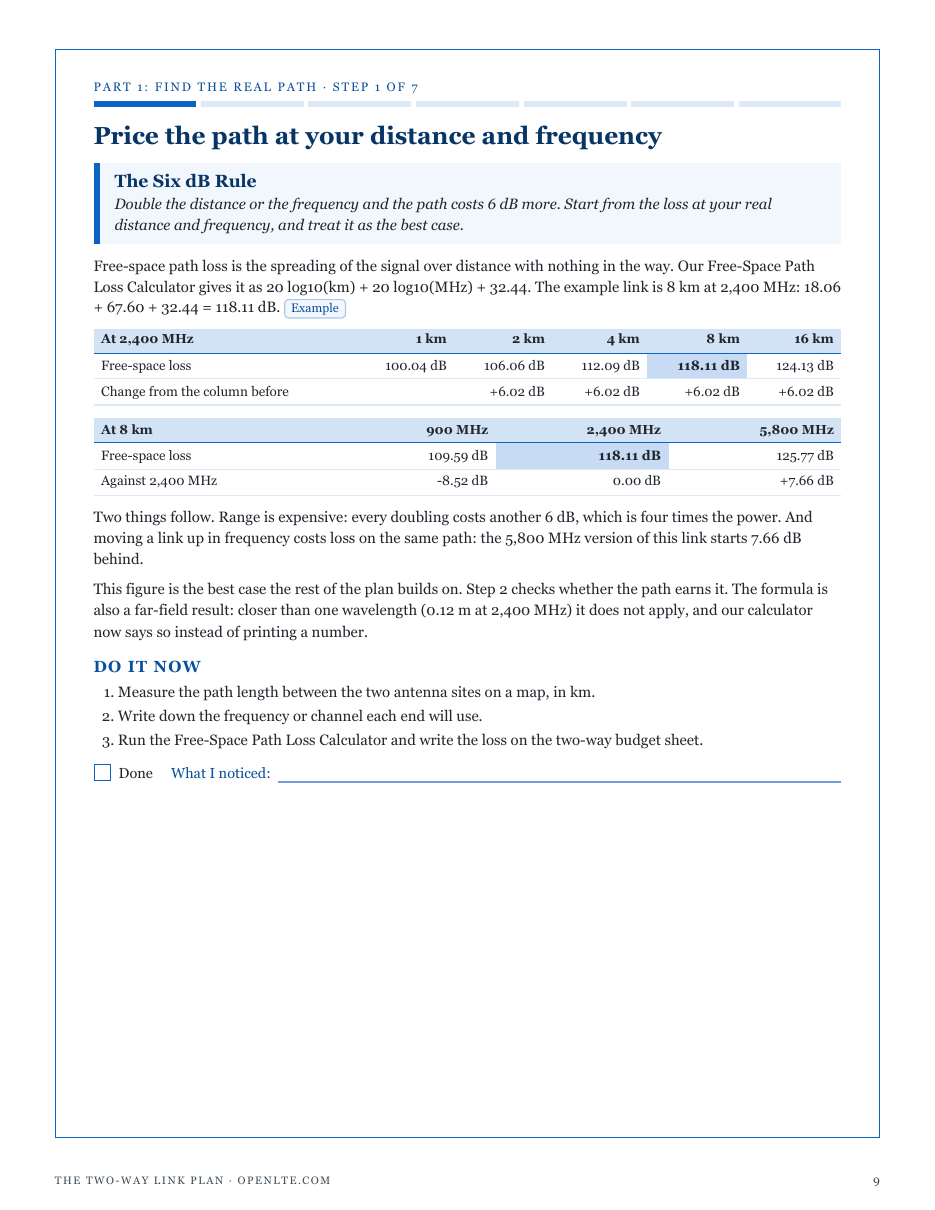
- The Six dB Rule: the free-space path loss at your real distance and frequency, and what each doubling costs
- The Sixty Percent Rule: the clearance the line of sight needs above every obstacle, earth bulge included, with tower and roof safety
- The Feedline Rule: the cable and connector loss at both ends, counted before any antenna gain
- The Weaker Direction Rule: the link budget run from both ends, and why the weaker direction is the link
- The Fade Rule: a 10 or 20 dB fade margin, how far the link reaches at each, and what a fade costs in capacity
- The Two-Way dB Rule: every fix priced by what it adds to the weaker direction and checked against the EIRP ceiling
- The Ceiling Rule: EIRP against your band's limit, the licensing check, and an RF exposure first screen
- Three working pages: a two-way budget sheet, a path survey sheet and an upgrade ledger
- A path reference (path loss and midpoint clearance by distance and band) and a power, gain and exposure-limit reference
- A personalised sheet worked from the figures you enter in the link budget, path loss, dBm and antenna gain calculators
Run one of the free calculators first and buy from that page, and this sheet is computed from your own figures. Buy from here and the pack still arrives complete — the sheet simply has no numbers of yours to work from yet.
14-day refund, no questions asked. If the pack is not what you needed, email support@graburl.com and we refund you in full — you do not have to justify it or delete the file. Full policy.
$19.00 including any taxes · PDF, 24 pages · instant download, link valid 7 days and 5 downloads.
Sold by GrabURL. The charge appears on your statement as GrabURL.
Refund policy · Terms of sale · support@graburl.com