The Jewelry Insurance Record
A one-page record for every piece of fine jewelry you own: its weight in grams, its stones taken off that weight, its purity at the lower of the karat and the hallmark, its report beside the estimate, and a schedule that reads your policy's theft limit two ways and keeps up with the metal inside each appraisal
RichPiece's calculators each answer for one thing at a time. The Gold Value Calculator prices whatever weight it is given, stones included; the Gemstone Weight Calculator estimates carats but never meets the grading report; and nothing on the site sets a piece's metal, its appraisal and the jewelry theft limit in a homeowners policy side by side, which is where jewelry ends up underinsured or insured for an old price tag. The record does that, piece by piece. Weigh in grams (a kitchen ounce typed in as a troy ounce prices metal 9.71% high), take each stone off at 0.2 g a carat, price purity at the lower of the karat fraction and the hallmark (24k at 999, 22k at 916), and let the report's weight win over the estimate. Then keep three numbers apart: melt at today's spot, the appraisal's replacement figure, and written offers. Example: five pieces appraised at $14,520, all taken in one burglary, against a $1,500 theft limit: read per piece the policy pays at most $6,420, read per loss $1,500. Schedule four, and once a year move only the metal in each appraisal to today's spot: an 18k chain appraised at $1,900 when gold was $2,150 an ounce comes to $2,454.60 at an example $3,300. It is not an appraisal, investment advice or insurance advice, and it cannot tell you what a stone is: a qualified gemologist can. Every figure in it is an example, and every source is quoted (NIST, the International Gem Society, the UK Assay Offices, GIA, the FTC Jewelry Guides, the Insurance Information Institute). Included: 7 steps, a piece record sheet, a collection schedule, an annual review card, a documents and photos checklist, reference tables, a quickstart, and a personalised sheet worked from the numbers you enter in our calculators.
What’s inside
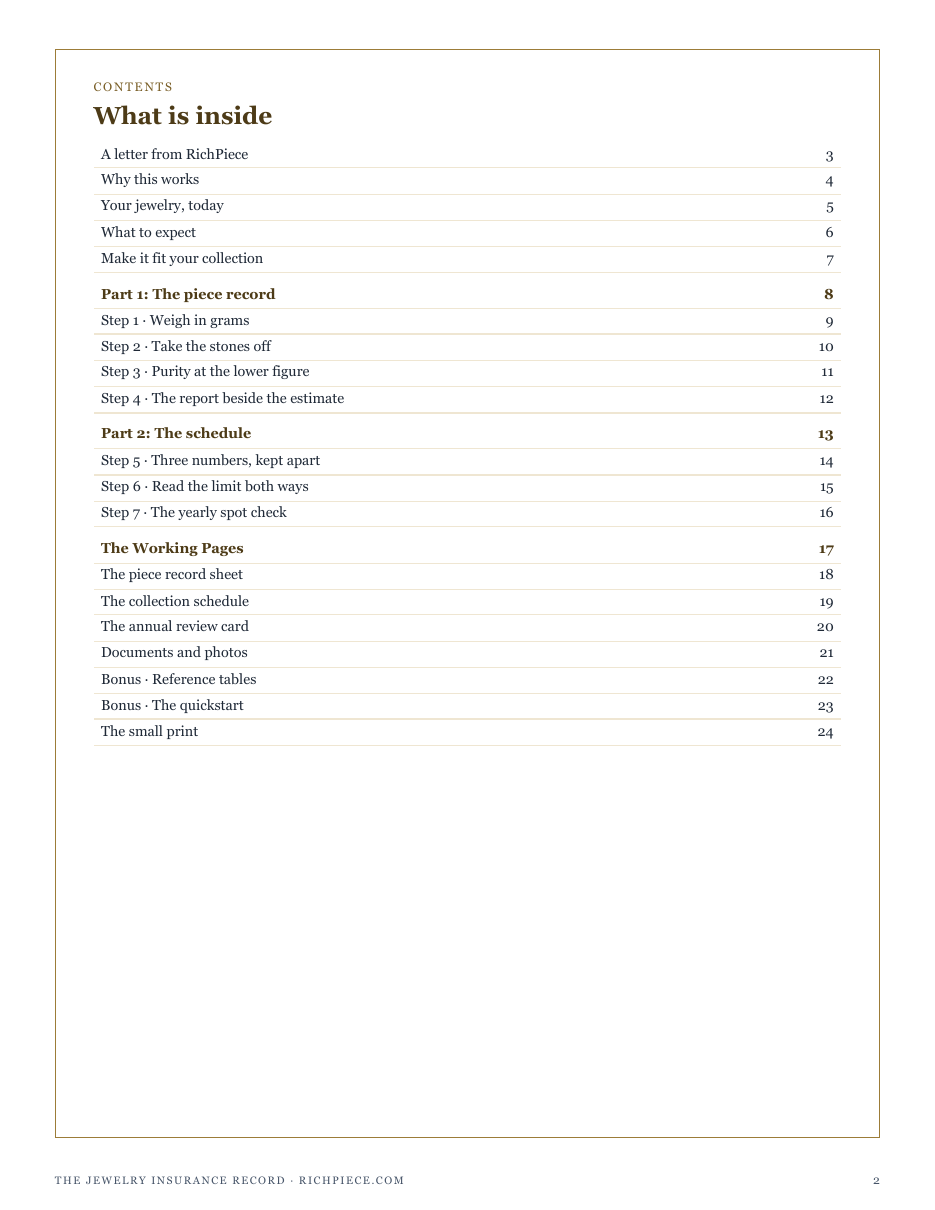
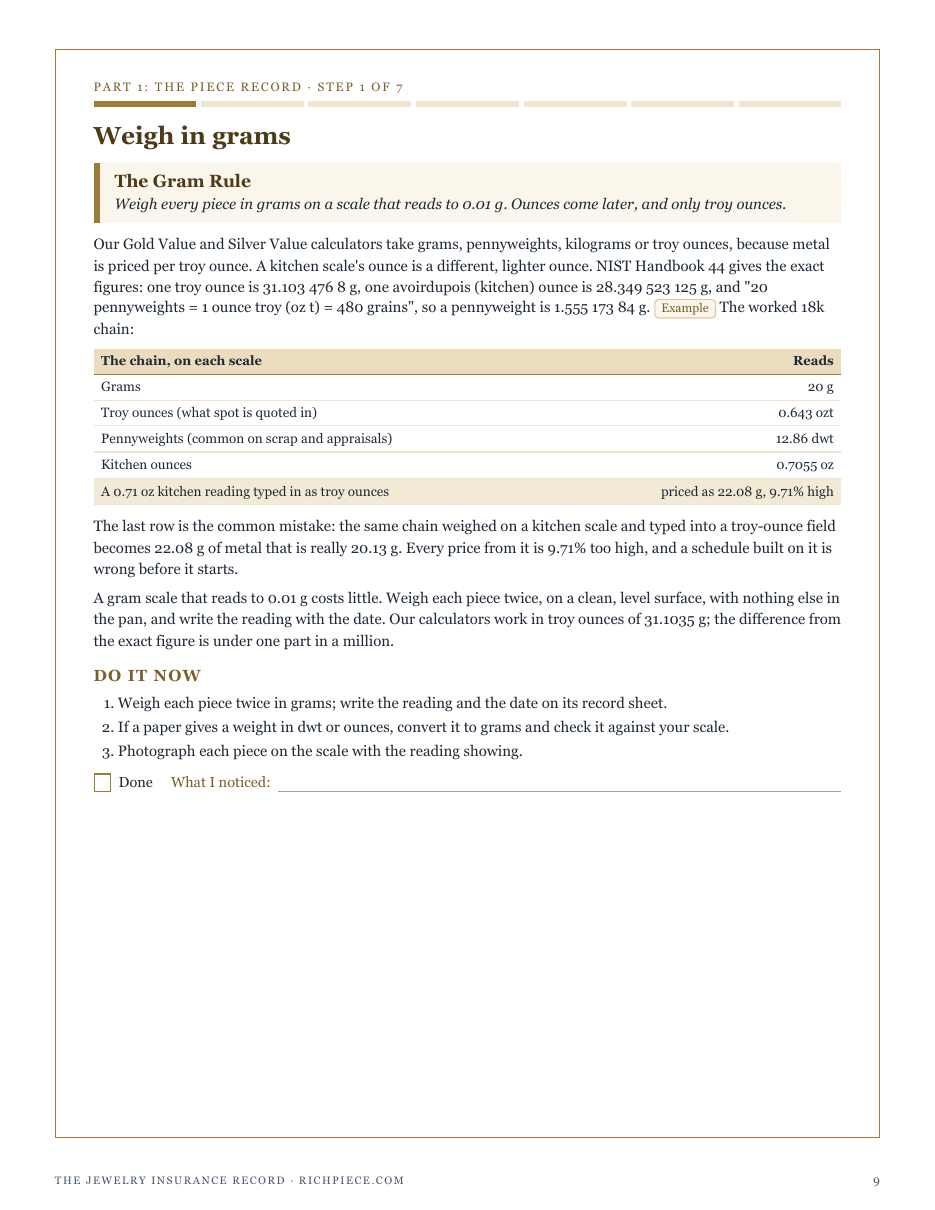
- Step 1: weigh in grams; troy ounces, pennyweights and kitchen ounces from NIST, and the 9.71% kitchen-ounce mistake
- Step 2: take the stones off the scale weight at 0.2 g a carat, estimated with the IGS formulas or copied from the report
- Step 3: purity at the lower of the karat fraction and the hallmark, never rounded up, and fine metal per piece
- Step 4: the report's weight beside the estimate, and the IGS girdle band that says when to ask a gemologist
- Step 5: three numbers kept apart: melt at today's spot, the appraisal's replacement figure, and written offers
- Step 6: your policy's jewelry theft limit read per piece and per loss, and which pieces to schedule
- Step 7: the yearly spot check: each appraisal's metal moved to today's spot, and when to re-appraise, up or down
- Working pages: a piece record sheet, a collection schedule, an annual review card, and a documents and photos checklist
- Reference tables: exact units, the IGS shape factors, and estimated carats for round stones by diameter
- A personalised sheet worked from the numbers you enter in the Gemstone Weight, Gold Value, Silver Value and Diamond Price calculators
Run one of the free calculators first and buy from that page, and this sheet is computed from your own figures. Buy from here and the pack still arrives complete — the sheet simply has no numbers of yours to work from yet.
14-day refund, no questions asked. If the pack is not what you needed, email support@graburl.com and we refund you in full — you do not have to justify it or delete the file. Full policy.
$15.00 including any taxes · PDF, 24 pages · instant download, link valid 7 days and 5 downloads.
Sold by GrabURL. The charge appears on your statement as GrabURL.
Refund policy · Terms of sale · support@graburl.com